

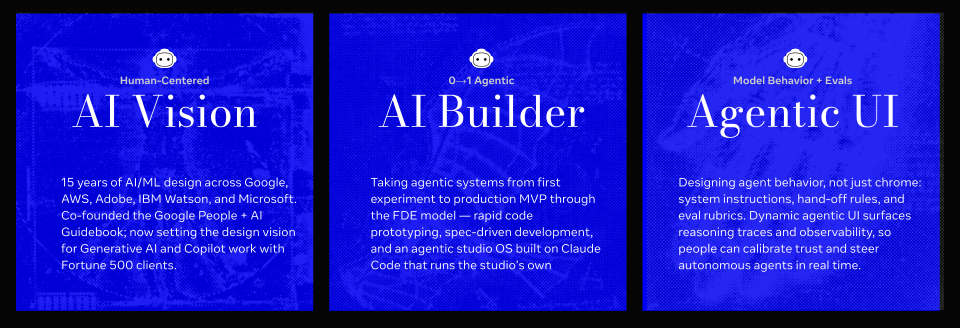
Han-Shen Chen is a Principal Designer at Microsoft AI Acceleration Studio with fifteen years of experience designing and shipping AI and machine-learning products at Microsoft, Google, AWS, Adobe, and IBM. He co-founded the Google People + AI Guidebook and has focused his career on human-centered AI—designing how people understand, interact with, and steer intelligent systems across consumer and enterprise products.
At Microsoft, he leads agentic product design and AI solutions for Fortune 500 clients, working closely with engineers and data scientists to translate emerging model capabilities into AI-native product experiences. He designs and builds working prototypes using Claude Code and Codex, testing interaction concepts against model behavior and integrating evaluation and observability from the first working build. His current work explores new interface patterns for generative and agentic AI, moving beyond prompt-and-response interactions toward experiences where people can understand, steer, and collaborate with AI agents.
Tokyo Spectrum Talk
Bill Gates once mentioned that the graphical user interface revolutionized how people interact with machines, establishing UX design as a crucial aspect of technology development. Today, UX design professionals are overwhelmed by new generative AI tools and are seeking effective ways to use them to 'automate' current UX design methods and systems. In this talk, instead of use AI as an automation tool I want to introduce a mindset focused on rethinking 'constancy and change' in AI UX design. By adopting this approach, we can create new possibilities to shape the relationship between people and AI.

Co-Lead of People AI Guidebook
The People + AI Guidebook is a living, evolving collection of practical guidance and best practices for designing human-centered AI products. Our recommendations are based on data and insights from over a hundred Googlers, industry experts, and academic research.

Google Taiwan AI Bootcamp
Project Lead and Speaker of Google Taiwan AI Bootcamp for main university education professors in Taiwan
Perosnal AI research: AUI
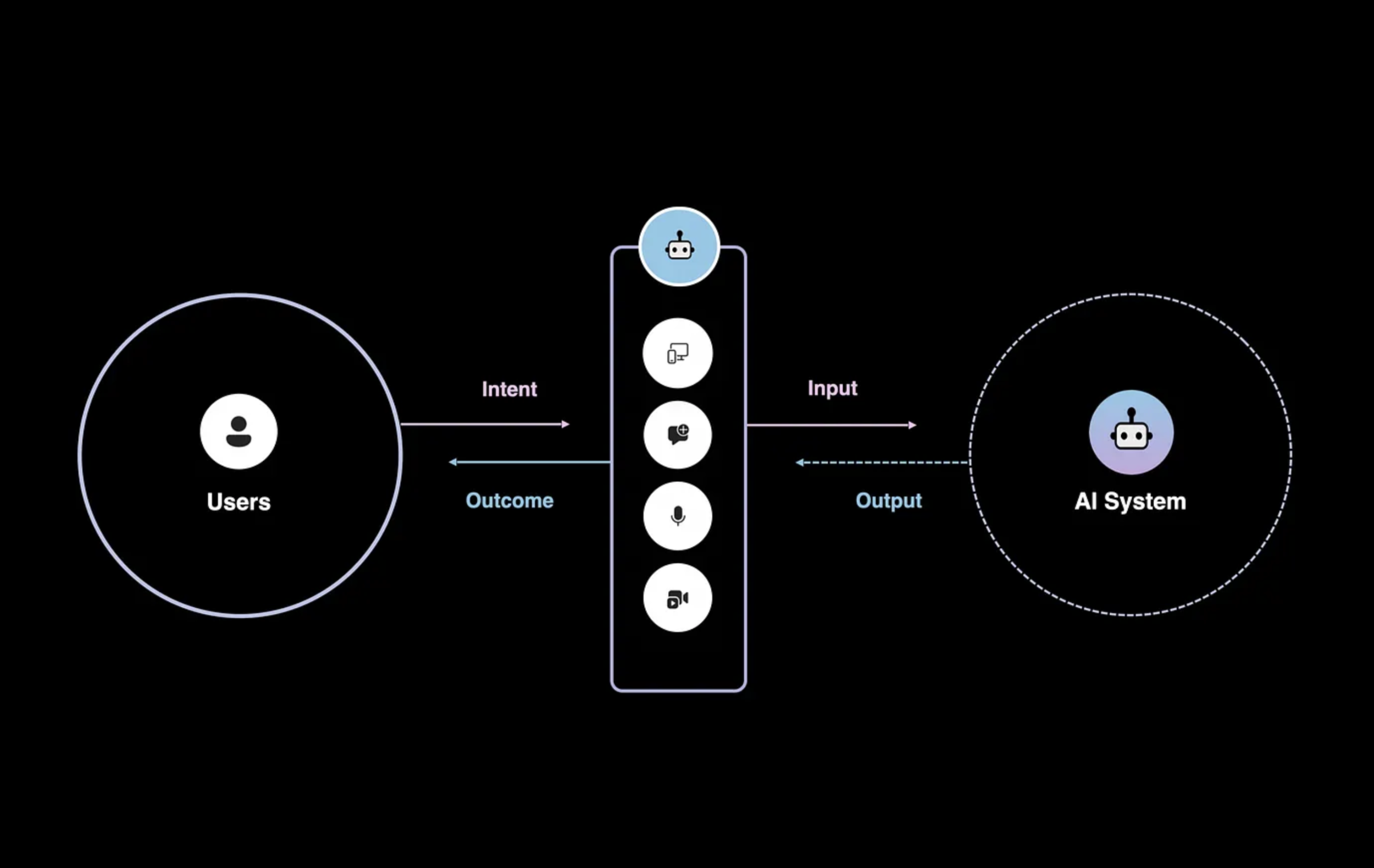
With the rise of GenAI systems, the user-AI relationship has fundamentally evolved. Today’s AI models are capable of interpreting complex, ambiguous, and multimodal intents — whether expressed through text, speech, visuals, or actions. Rather than expecting a perfectly formatted input, AI systems can understand what the user wants, even if it’s not stated precisely.
Check the full article